A desk is usually a piece of furniture with a flat surface used for writing, studying, working, reading, or using a computer. Depending on the setting, however, the word can refer to much more than furniture.
In offices, a desk may mean a workstation or department; in journalism, it can refer to a news division; and in customer service, a desk may mean a service counter.
That is why the best alternative depends on what desk means in your sentence. Words such as workstation, table, counter, bureau, and reception can work in specific situations, but they are not perfect substitutes in every context. This guide explains the most useful alternatives, their differences, examples, appropriate contexts, and common mistakes.
Quick Answer
Common synonyms for desk include workstation, table, bureau, counter, writing table, worktable, reception, office, station, and work area. The best choice depends on the meaning.
Workstation usually refers to a place for working, counter describes a service surface, and bureau can mean either a desk or an office/department.
Quick List of Alternatives for Desk
Closest Alternatives
- Workstation
- Writing table
- Worktable
- Bureau
- Table
- Work area
- Work surface
Formal or Professional Alternatives
- Workstation
- Office station
- Work area
- Bureau
- Service counter
- Reception desk
- Information desk
- Administrative office
Neutral Alternatives
- Table
- Workstation
- Counter
- Work surface
- Work area
- Station
- Writing table
Contextual Alternatives
- Reception
- Information counter
- Service counter
- Front office
- Newsroom desk
- Help desk
- Checkout counter
- Cashier station
- Teacher’s station
Formal Alternatives for Desk

The following words can replace desk in particular contexts. Most are contextual alternatives rather than exact synonyms.
1. Workstation
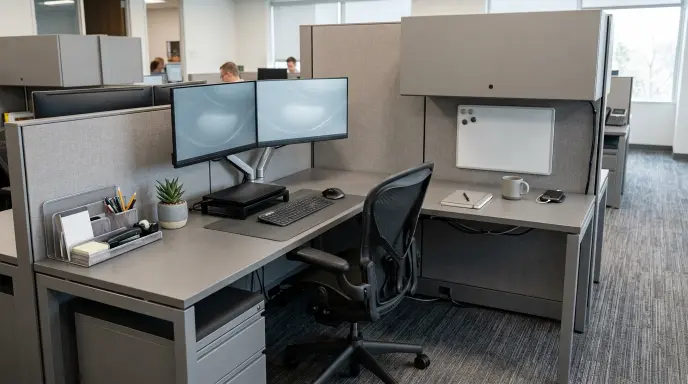
Meaning: A place equipped for a person’s work, often including a desk, computer, chair, and related equipment.
Explanation: Workstation is one of the most useful professional alternatives. It focuses on the entire working setup rather than just the furniture.
Example: Each employee has a dedicated workstation.
Best Use: Offices, technology, corporate writing, and workplace descriptions.
Worst Use: A sentence specifically describing an antique wooden desk.
Tone: Professional and modern.
2. Bureau
Meaning: A bureau can mean a writing desk with drawers or an office or department responsible for particular work.
Explanation: The furniture meaning is somewhat traditional, while the organizational meaning remains common in phrases such as government bureau.
Example: She kept the documents in the drawers of her bureau.
Best Use: Furniture descriptions, historical writing, and certain organizational contexts.
Worst Use: Modern workplace writing where desk or workstation is clearer.
Tone: Formal or traditional.
3. Writing Table
Meaning: A table designed for writing, reading, or similar activities.
Explanation: This is a close furniture-related alternative to desk. It emphasizes writing rather than computer-based work.
Example: He placed the manuscript on a small writing table.
Best Use: Furniture descriptions, literature, homes, and traditional settings.
Worst Use: A modern office environment where the object functions as a complete workstation.
Tone: Neutral and somewhat traditional.
4. Worktable
Meaning: A table used for practical or professional work.
Explanation: A worktable is broader than a traditional desk. It may be used for crafting, repairing, assembling, designing, or other tasks.
Example: The technician arranged the tools across the worktable.
Best Use: Workshops, studios, laboratories, and practical workspaces.
Worst Use: A formal office where workstation is more accurate.
Tone: Neutral and practical.
5. Work Area
Meaning: The place where someone performs work.
Explanation: Work area describes a location rather than a particular piece of furniture.
Example: Please keep your work area clean and organized.
Best Use: Workplace policies, safety instructions, and general descriptions.
Worst Use: When you specifically need to identify a desk.
Tone: Professional and neutral.
6. Work Surface
Meaning: A flat surface used for working.
Explanation: This term focuses on the functional surface rather than the complete piece of furniture.
Example: The designer needed a larger work surface for the project.
Best Use: Design, manufacturing, workshops, offices, and furniture descriptions.
Worst Use: Casual conversation where desk is simpler.
Tone: Technical and neutral.
7. Office Station
Meaning: A designated place where an employee performs office work.
Explanation: This phrase emphasizes a specific working position within an office.
Example: The new office station includes an adjustable monitor stand.
Best Use: Workplace planning and office design.
Worst Use: Describing a simple home desk.
Tone: Professional.
8. Administrative Office
Meaning: A room or area used for administrative work.
Explanation: This is not a direct furniture synonym. It can replace desk only when desk means an office or administrative function.
Example: Please submit the form to the administrative office.
Best Use: Schools, businesses, hospitals, and institutions.
Worst Use: Referring to a physical table.
Tone: Formal.
9. Reception Desk
Meaning: A desk or counter where visitors are greeted and assisted.
Explanation: This is a narrower type of desk rather than a general synonym.
Example: Please leave your visitor badge at the reception desk.
Best Use: Hotels, offices, clinics, schools, and other public-facing locations.
Worst Use: A private employee’s desk.
Tone: Professional.
10. Information Desk
Meaning: A designated place where people can ask for information or assistance.
Explanation: An information desk is a specific service point, usually in a public institution.
Example: You can ask for directions at the information desk.
Best Use: Libraries, museums, airports, stores, and public buildings.
Worst Use: A personal workspace.
Tone: Professional and neutral.
Semi-Formal and Neutral Alternatives
11. Table
Meaning: A piece of furniture with a flat surface supported by legs or another structure.
Explanation: A table can function like a desk, but not every table is a desk. A table is usually more general and may be designed for dining, meetings, or other activities.
Example: She placed her laptop on the table.
Best Use: General descriptions.
Worst Use: When the furniture is specifically designed as a professional workstation.
Tone: Neutral.
12. Counter
Meaning: A raised or flat surface used for serving, selling, preparing, or receiving items.
Explanation: Counter works when the desk functions as a service point.
Example: Please return the form to the service counter.
Best Use: Stores, banks, reception areas, and customer service.
Worst Use: A personal office workstation.
Tone: Neutral and professional.
13. Station
Meaning: A designated place where a person performs a particular activity.
Explanation: Station is broader than desk. It can refer to a cashier station, work station, teaching station, or service station.
Example: Please return to your assigned station.
Best Use: Offices, retail, education, transportation, and service environments.
Worst Use: When describing the furniture itself.
Tone: Neutral.
14. Work Space
Meaning: An area where someone works.
Explanation: Workspace refers to the environment or area rather than specifically to a desk.
Example: She created a quiet workspace at home.
Best Use: Remote work, offices, studying, and home organization.
Worst Use: When a sentence specifically refers to a physical desk.
Tone: Modern and neutral.
15. Office Furniture
Meaning: Furniture designed for use in an office.
Explanation: This is a broad category that can include desks, chairs, cabinets, and tables.
Example: The company purchased new office furniture.
Best Use: General furniture discussions.
Worst Use: When you need to identify one specific item.
Tone: Neutral.
16. Study Table
Meaning: A table designed or used for studying.
Explanation: This is a useful alternative when desk refers to furniture used by a student.
Example: He organized his books on his study table.
Best Use: Bedrooms, classrooms, home study areas, and student spaces.
Worst Use: Corporate office settings.
Tone: Neutral.
17. Computer Table
Meaning: A table designed for a computer and related equipment.
Explanation: This term emphasizes the equipment being used rather than the broader purpose of the furniture.
Example: The computer table has space for two monitors.
Best Use: Home offices, gaming rooms, and computer setups.
Worst Use: Formal corporate writing where workstation may be more appropriate.
Tone: Neutral and practical.
18. Workbench
Meaning: A strong table or bench designed for practical, technical, mechanical, or craft work.
Explanation: A workbench is not a general synonym for desk. It is appropriate when the work involves tools or physical tasks.
Example: The mechanic placed the equipment on the workbench.
Best Use: Workshops, garages, laboratories, and studios.
Worst Use: Ordinary office work.
Tone: Practical.
19. Console
Meaning: A specialized surface or structure used for operating equipment or controlling a system.
Explanation: In certain technical contexts, a console may serve a function similar to a workstation, but it is not a general desk synonym.
Example: The operator monitored the system from the control console.
Best Use: Technology, broadcasting, transportation, and control rooms.
Worst Use: Everyday office writing.
Tone: Technical.
20. Front Office
Meaning: The area or department that interacts directly with customers, visitors, or clients.
Explanation: This is a contextual alternative when desk refers to a public-facing office function.
Example: Please contact the front office for assistance.
Best Use: Hotels, schools, clinics, and organizations.
Worst Use: A physical desk in a private office.
Tone: Professional.
Informal and Casual Alternatives
Unlike many abstract nouns, desk has relatively few true casual synonyms. People normally continue using desk in everyday conversation because it is short and clear. However, these contextual expressions may work naturally.
1. Table
Example: “Just put your laptop on the table.”
When It Sounds Natural: Casual conversation when the exact type of furniture is not important.
When to Avoid It: When you need to distinguish a desk from a dining or coffee table.
Tone: Casual and neutral.
2. Work Spot
Example: “I found a quiet work spot near the window.”
When It Sounds Natural: Informal conversations about where someone works.
When to Avoid It: Formal reports or professional documents.
Tone: Casual.
3. Workspace
Example: “I need to clean up my workspace.”
When It Sounds Natural: Talking about a personal area used for work or study.
When to Avoid It: When you specifically mean the physical desk.
Tone: Modern and conversational.
4. Work Area
Example: “Keep your work area tidy.”
When It Sounds Natural: Everyday instructions and workplace conversations.
When to Avoid It: When the exact piece of furniture matters.
Tone: Neutral.
5. Setup
Example: “My new desk setup has two monitors.”
When It Sounds Natural: Technology, gaming, home office, and casual discussions.
When to Avoid It: Formal writing.
Tone: Casual and modern.
True Synonyms vs. Contextual Alternatives
The word desk has fewer exact synonyms than it may appear to have. Many alternatives describe something that performs a similar function but is not technically the same object.
| Type | What It Means | Can It Replace the Original? |
|---|---|---|
| True synonym | A word with essentially the same meaning in the same context | Sometimes |
| Near synonym | A similar piece of furniture or workspace | Often, depending on context |
| Contextual alternative | A term used when the desk has a specific function | Only in that context |
| Broader expression | A term covering a larger category or area | Sometimes |
| Narrower expression | A particular type of desk | Only when that specific type is intended |
For example, writing table can be a close furniture alternative, but workstation describes a broader working setup. Counter may replace desk at a reception or service point, but it would not normally describe a private office desk.
Industry-Specific Usage
Business Writing
Business writing often uses workstation, work area, office station, workspace, or reception desk depending on the context.
Instead of:
Employees should keep their desks organized.
You could write:
Employees should keep their workstations organized.
The second version may be preferable when the organization is referring to the entire employee setup, including the computer and equipment.
Corporate Communication
Corporate documents often distinguish between a desk, workstation, and office.
For example:
Employees may request an ergonomic workstation assessment.
Here, workstation refers to more than the physical desk. It may include the chair, monitor, keyboard, and other equipment.
Academic Writing
Academic writing normally favors desk when describing furniture and workstation or study area when describing a broader working environment.
Example:
Students were provided with individual workstations.
This suggests designated spaces rather than merely individual tables.
Customer Service
Customer service commonly uses service counter, help desk, information desk, and reception desk.
Example:
Please visit the information desk if you need assistance.
A help desk can also refer to a support service, particularly in technology.
Legal Writing
Legal writing generally uses the most precise term available. If a contract or policy refers to a specific piece of furniture, desk may be preferable to a vague alternative.
If desk refers to an organizational function, the intended department or office should be identified clearly.
For example, help desk, service desk, and front office can have specific operational meanings. A general synonym should not be substituted if it changes the intended scope.
Email Communication
Professional emails can use desk, workstation, office, reception, information desk, or service counter depending on what the recipient needs to locate.
Example:
Please leave the signed document at the reception desk.
This is more precise than simply saying:
Please leave the document at the office.
Email Examples
1. Office Workstation
Subject: New Workstation Setup
Hi James,
Your new workstation has been set up and is ready for use. The monitor and docking station have also been connected.
Please let me know if you need any additional equipment.
Best,
Sarah
2. Reception Desk
Subject: Visitor Arrival
Hello Mark,
Your guest is expected at 10:00 a.m. Please ask them to check in at the reception desk when they arrive.
Thanks,
Emily
3. Information Desk
Subject: Event Information
Dear Students,
If you have questions about tomorrow’s event, please visit the information desk in the main lobby. Staff members will be available throughout the morning.
Best,
Student Services
4. Service Counter
Subject: Document Collection
Hello,
Your documents are ready for collection. Please visit the service counter during regular office hours and bring a valid form of identification.
Kind regards,
Customer Support
5. Study Area
Subject: New Study Area Available
Dear Students,
A new study area is now available on the second floor of the library. Each workspace includes access to power outlets and high-speed internet.
Best,
Library Staff
6. Front Office
Subject: Appointment Confirmation
Hello Mrs. Carter,
Your appointment has been confirmed for Thursday at 2:00 p.m. Please check in at the front office when you arrive.
Sincerely,
Reception Team
Short Dialogue Examples
Workplace
Person A: Where should I set up my computer?
Person B: Your new workstation is next to the window.
Classroom
Person A: Can I move this desk closer to the board?
Person B: Sure, as long as you leave enough space for everyone to walk through.
Customer Service
Person A: Where can I return this form?
Person B: Please take it to the service counter near the entrance.
Casual Conversation
Person A: Where do you usually work from home?
Person B: I have a small workspace in my bedroom.
Professional Discussion
Person A: Should we replace the desks in the meeting room?
Person B: I think a larger worktable would make better use of the space.
How to Replace “Desk” in a Sentence
Example 1
Original:
Each employee has a desk.
Alternative:
Each employee has a workstation.
Why it works:
Workstation emphasizes the complete work setup rather than only the furniture.
Example 2
Original:
Please leave the form at the desk.
Alternative:
Please leave the form at the service counter.
Why it works:
Service counter is more precise when the desk is used for customer service.
Example 3
Original:
She writes at her desk every morning.
Alternative:
She writes at her writing table every morning.
Why it works:
Writing table emphasizes writing as the primary purpose.
Example 4
Original:
He keeps his tools on the desk.
Alternative:
He keeps his tools on the workbench.
Why it works:
A workbench is more appropriate for practical or mechanical work.
Example 5
Original:
I spend most of the day at my desk.
Alternative:
I spend most of the day at my workstation.
Why it works:
This sounds natural in a modern workplace and can include the computer and equipment.
Example 6
Original:
Ask someone at the desk for help.
Alternative:
Ask someone at the information desk for help.
Why it works:
The alternative clearly identifies the purpose of the desk.
Example 7
Original:
She organized her desk before the meeting.
Alternative:
She organized her work area before the meeting.
Why it works:
Work area broadens the meaning from the physical desk to the surrounding workspace.
Example 8
Original:
Please wait at the desk.
Alternative:
Please wait at the reception desk.
Why it works:
Reception desk tells visitors exactly where they should wait.
Example 9
Original:
The students sat at their desks.
Alternative:
The students sat at their study tables.
Why it works:
Study tables works when the furniture is specifically used for studying.
Comparison Table
| Phrase | Tone | Meaning / Scope | Best Use | Example |
|---|---|---|---|---|
| Desk | Neutral | Furniture or organizational function | General use | Put it on my desk |
| Workstation | Professional | Complete work setup | Offices | Her workstation is ready |
| Writing table | Neutral | Table intended for writing | Homes, literature | He sat at the writing table |
| Worktable | Practical | Table for hands-on work | Workshops | Tools are on the worktable |
| Table | Neutral | General flat furniture | Everyday use | Put it on the table |
| Counter | Neutral | Service or transaction surface | Retail, service | Visit the counter |
| Work area | Professional | Area used for work | Policies, offices | Keep your work area clean |
| Workspace | Modern | Area or environment for working | Remote work | My workspace is upstairs |
| Workbench | Practical | Heavy-duty work surface | Workshops | Use the workbench |
| Reception desk | Professional | Visitor service point | Offices, hotels | Check in at reception |
| Information desk | Professional | Information and assistance point | Public facilities | Ask at the information desk |
| Station | Neutral | Assigned place for an activity | Workplaces, services | Return to your station |
| Bureau | Formal/Traditional | Desk or organizational office | Furniture, institutions | The bureau has drawers |
Which Alternative Should You Choose?
For Formal Writing
Use workstation, work area, bureau, or office station when the context calls for a more formal or specialized expression.
For Business Communication
Workstation is usually the strongest alternative when you mean an employee’s complete working setup. Use work area when referring to a larger physical area.
For Academic Writing
Use study area, workstation, study table, or writing table according to the physical environment you are describing.
For Legal Writing
Use desk unless a more specific term is necessary. Precision is more important than vocabulary variation.
For Professional Email
Use reception desk, information desk, service counter, workstation, or front office when those terms accurately identify the location or function.
For Everyday Conversation
Keep desk when possible. Table and workspace can work when the exact type of furniture is not important.
For Casual Messages
Words such as desk, table, workspace, and setup sound natural. Avoid unnecessarily technical expressions such as office station unless the context requires them.
Grammar and Usage Guide
“Desk” Is a Countable Noun
Use a desk when referring to one unspecified desk.
She bought a desk for her bedroom.
Use desks for more than one.
The classroom has twenty desks.
Use “At the Desk” for a Location
When someone is working or waiting at a desk, at is usually natural.
She is sitting at her desk.
Someone is waiting at the reception desk.
Use “On the Desk” for Objects
Use on when something is physically placed on the desk surface.
The report is on my desk.
Please leave the keys on the desk.
“Under the Desk” Refers to Position
The computer tower is under the desk.
“Behind the Desk” Can Describe a Person’s Position
The receptionist was sitting behind the desk.
Desk vs. Desktop
These words should not be confused.
A desk is furniture.
A desktop can refer to the top surface of a desk or, in computing, the main screen area of a computer.
Desk vs. Workstation
A desk is primarily a piece of furniture. A workstation usually describes the entire place or setup used for work.
The new desk is made of wood.
The new workstation includes a desk, monitor, chair, and docking station.
Capitalization
The word desk is normally lowercase unless it appears at the beginning of a sentence or forms part of a proper name.
She cleaned her desk.
The Help Desk is open until 6 p.m.
Common Mistakes to Avoid
1. Treating “Table” as an Exact Synonym
A table can function as a desk, but not every table is a desk. Use table only when the broader meaning is acceptable.
2. Using “Workstation” for Furniture Only
A workstation often refers to the entire work setup. If you are discussing the furniture itself, desk may be more accurate.
3. Calling Every Counter a Desk
A counter is usually designed for serving, transactions, preparation, or customer interaction. It is not simply another word for every type of desk.
4. Using “Bureau” in Modern Office Writing
Although bureau can mean a desk, that sense can sound old-fashioned in contemporary American English. In most modern workplaces, desk or workstation is clearer.
5. Confusing “Workspace” With “Desk”
A workspace is an area or environment. A desk is a specific piece of furniture.
6. Using “Workbench” for Office Work
A workbench usually supports hands-on tasks, tools, repairs, crafts, or technical work. It may not suit ordinary office work.
7. Choosing a Narrower Term Without Context
Words such as reception desk and information desk identify specific functions. Do not use them if the desk serves a different purpose.
8. Replacing “Desk” Just to Avoid Repetition
Sometimes desk is the clearest word available. Forced variation can make writing less precise rather than more sophisticated.
When Not to Use “Desk”
When You Mean the Entire Work Setup
Use workstation if you mean the desk, computer, monitor, chair, and other equipment together.
When You Mean a General Working Area
Use workspace or work area.
When You Mean a Customer Service Point
Use service counter, reception desk, or information desk as appropriate.
When You Mean Hands-On Work Furniture
Use workbench when the furniture is built for tools or practical tasks.
When You Mean a Study Location
Use study area when the emphasis is on the place rather than the furniture.
When You Mean an Organizational Department
In phrases such as news desk or help desk, the word can refer to a service or department rather than a physical piece of furniture. In these cases, replacing desk with table would change the meaning.
When “Desk” Is Already the Clearest Choice
Do not avoid the original word simply because you want variety. A precise, familiar word is often better than a less familiar synonym.
Advanced Writer Tips
Tone Control
For a simple, neutral tone, use desk or table. For professional workplace writing, workstation and work area may be more appropriate. For specialized environments, choose terms such as workbench or service counter.
Professional Email Etiquette
Use location-specific language when giving instructions.
Instead of:
Leave the document at the desk.
write:
Please leave the document at the reception desk.
The second sentence removes uncertainty and sounds more professional.
Politeness
The choice of noun can make instructions clearer without making them overly formal.
Please visit the information desk for assistance.
is direct and polite without unnecessary wording.
Context Alignment
Ask whether you are describing furniture, a workspace, a service point, or a department. This distinction is especially important because desk has several meanings.
Precision
Use the narrowest accurate term when the distinction matters.
For example:
- Desk = general furniture
- Workstation = complete work setup
- Reception desk = visitor-facing point
- Information desk = information service point
- Workbench = practical work surface
- Help desk = support service or support point
Readability
Do not replace a familiar word with a complicated expression without a clear reason.
Put the report on my desk.
is usually better than:
Place the report on my designated office workstation surface.
Clear writing does not require unnecessary vocabulary.
Related Questions
What is another word for desk?
Common alternatives include workstation, writing table, worktable, bureau, table, work area, workspace, and counter. The correct choice depends on whether you mean furniture, a working area, or a specific service point.
What is a professional alternative to desk?
Workstation is often the most useful professional alternative when referring to an employee’s work setup. Work area is another option when the meaning includes the surrounding space.
What is a formal word for desk?
Bureau is a traditional formal alternative for a desk, while workstation is more modern and professional. However, bureau may sound old-fashioned when referring to ordinary office furniture.
What can I use instead of desk?
Use table for general furniture, workstation for a professional setup, writing table for writing, workbench for hands-on tasks, or counter for service situations.
Is desk a formal word?
Yes. Desk is a standard neutral English word and works in formal, professional, academic, and everyday writing. There is usually no need to replace it simply to make writing sound more formal.
Can I use workstation instead of desk?
Sometimes. Workstation is appropriate when you mean a place equipped for work, especially in an office. It is not always a direct substitute because a workstation can include more than the physical desk.
What is the difference between a desk and a workstation?
A desk is mainly a piece of furniture with a working surface. A workstation generally refers to the complete place where someone works, which may include a desk, computer, monitor, chair, and other equipment.
FAQs
What is the closest synonym for desk?
There is no single perfect synonym for every use of desk. Writing table is a close furniture-related alternative, while workstation is a strong modern alternative when the meaning includes the entire working setup.
Is “table” another word for desk?
Sometimes, but not always. A desk is a specific type of furniture designed for work, writing, study, or similar activities. A table is a broader category that can be used for dining, meetings, work, or other purposes.
What is a desk called in an office?
In a modern office, a desk may also be called a workstation or work area, especially when referring to the employee’s complete setup. The word desk remains the most common term for the furniture itself.
What is another word for a reception desk?
Depending on the setting, alternatives include reception counter, reception area, front desk, and reception station. However, these terms can have slightly different meanings, so reception desk is often the clearest option.
What is another word for a study desk?
Useful alternatives include study table, writing table, study station, and study area. Study table usually refers to the furniture, while study area refers to the broader place where studying takes place.
What is another word for a help desk?
Depending on the organization, alternatives include support desk, service desk, support center, help center, and customer support. These terms can describe a service rather than a physical desk.
What is the difference between a desk and a counter?
A desk is generally designed as a workspace for an individual, while a counter is commonly used for serving customers, receiving items, making transactions, or preparing things. Their functions can overlap in some settings.
Key Takeaways
- Desk is already a clear, standard word, so it does not always need replacement.
- Workstation is useful when referring to a complete professional work setup.
- Writing table and study table work when the furniture’s purpose is writing or studying.
- Counter, reception desk, and information desk are narrower terms for service-oriented settings.
- Always choose the alternative based on the object’s function, context, audience, and intended meaning.
Conclusion
The best synonym for desk depends on what the word represents in your sentence. If you mean ordinary office furniture, desk is usually the clearest choice. For a complete professional setup, workstation may be more accurate.
Writing table suits writing-focused furniture, while study table works for student settings. A workbench belongs in practical or technical environments, and a counter is more appropriate for customer-facing activities.
Some alternatives describe not the furniture itself but its broader function. Workspace and work area refer to the surrounding place, while reception desk, information desk, and help desk identify particular purposes.
The goal should not be to replace desk with a more complicated word simply for variety. Instead, choose the term that gives readers the clearest and most accurate picture of the object, location, or function you mean.